

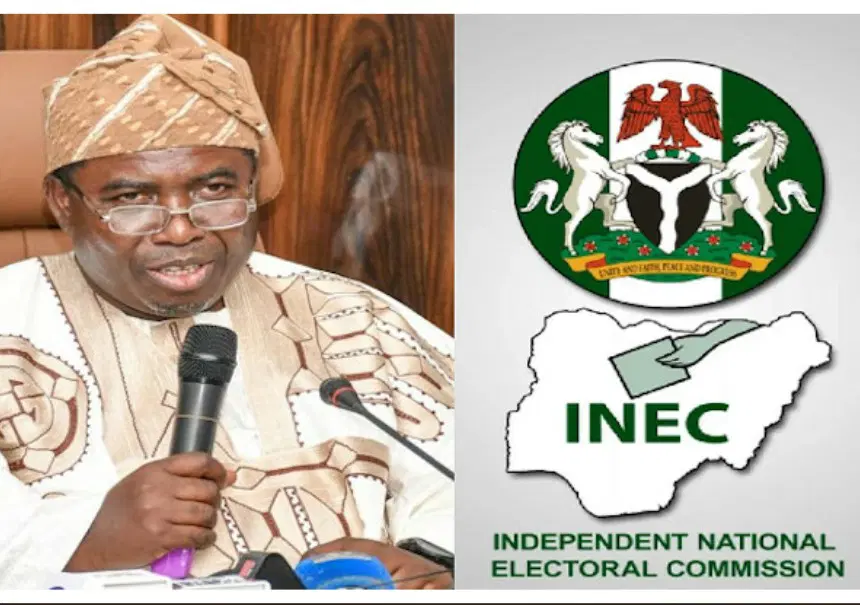
INEC Chief Gives Firm Warning Over Atiku’s 2027 Bid
Professor Joash Amupitan says INEC will comply with binding court orders as legal uncertainty surrounds the ADC leadership and Atiku Abubakar’s presidential ambition
The Chairman of the Independent National Electoral Commission (INEC), Professor Joash Amupitan, has reaffirmed the commission’s commitment to obeying binding court decisions on former Vice-President Atiku Abubakar’s eligibility for the 2027 presidential election, speaking at Chatham House in London on Thursday, November 12, 2026.
Also read: INEC Suspends Staff Leave Ahead of 2027 Elections
Amupitan made the position clear amid growing uncertainty over Atiku’s political future following a Federal High Court judgment that nullified the leadership structure of the African Democratic Congress (ADC), the opposition party on whose platform the former vice-president intends to contest.
Responding to a question about whether Atiku could remain eligible if the judgment was not overturned, the INEC chairman said the commission would be guided by the courts rather than political considerations.
“If he eventually fails, well, I’m obligated under Section 285 of the Constitution of Nigeria to obey every court order, especially if it is from the Supreme Court,” Amupitan said.
His comments place the responsibility for resolving the dispute firmly within the judicial process, as the ADC pursues an appeal against the ruling that has thrown its leadership and presidential nomination into uncertainty.
The controversy stems from a judgment delivered on November 5, 2026, by Justice Peter Lifu of the Federal High Court in Abuja.
The judge ruled in favour of Nafiu Bala Gombe, a former ADC national deputy chairman, who challenged the process through which former Senate President David Mark and his allies assumed control of the party.
The court invalidated the Mark-led caretaker leadership and nullified decisions taken by the affected leadership, including actions connected with the process that produced Atiku as the party’s presidential candidate.
The ruling also raised questions about the legitimacy of the party’s leadership arrangements and the political decisions taken under the disputed structure.
However, the judgment has not brought the dispute to a close.
The ADC announced on November 6 that it had filed a notice of appeal at the Court of Appeal and applied for a stay of execution pending the determination of the case.
The party also formally notified INEC, urging the commission to avoid taking steps that could pre-empt the appellate court’s decision.
The party’s Director of Strategic Communication, Phrank Shaibu, maintained that the legal challenge was necessary to protect the party’s rights and allow the judicial process to run its course.
The appeal has become particularly significant because the dispute extends beyond the question of who controls the ADC. It also concerns the validity of the party’s internal decisions and the process through which Atiku emerged as its presidential flagbearer.
Atiku, who served as Nigeria’s vice-president from 1999 to 2007, secured the ADC presidential ticket in May 2026. The 2027 contest would represent another attempt by the former presidential candidate to secure the presidency after several unsuccessful bids.
The former vice-president has maintained that the court ruling will not end his presidential ambition. He has argued that Nigerians, rather than political manoeuvres, should ultimately determine who leads the country.
Atiku has also criticised what he described as attempts to weaken opposition politics through political pressure and court manoeuvres, raising concerns about the country’s democratic environment.
Meanwhile, Amupitan disclosed that INEC was facing more than 300 pending court cases, warning that the volume of litigation could complicate preparations for the 2027 general election.
He said the commission had previously advocated an accelerated resolution of pre-election disputes, preferably within three weeks of emerging, to prevent prolonged litigation from disrupting electoral planning.
The INEC chairman also proposed that pre-election disputes should ideally be concluded six months to one year before an election to give the commission sufficient time to organise its logistics.
According to him, INEC had already commenced the procurement of sensitive election materials, making unresolved legal disputes a significant concern.
Amupitan expressed frustration that the commission often bears public criticism when implementing judicial decisions, even when it is simply carrying out its legal responsibilities.
He explained that the consequences of court decisions are frequently transferred to INEC, leaving the commission exposed to criticism from political actors and their supporters.
The chairman’s remarks underscore the delicate position of the electoral commission as Nigeria approaches another election cycle, with political parties increasingly engaging in legal battles over leadership, nominations and eligibility.
There is also an important distinction between the court’s judgment and the eventual outcome of the appeal. The ADC’s application for a stay of execution had not been determined when the party announced its appeal, meaning the legal proceedings remained active.
INEC had also previously indicated that it would not act on social media reports or unverified accounts of court decisions.
Amupitan said the commission needed to obtain the Certified True Copy of a judgment, examine its contents and seek appropriate legal advice before taking consequential administrative steps.
One constitutional detail also deserves clarification. Although Amupitan referred to Section 285 when discussing the commission’s obligation to obey court orders, Section 287 of the 1999 Constitution specifically addresses the enforcement of decisions of the Supreme Court, Court of Appeal and other constitutionally established courts.
Section 285 primarily deals with election tribunals and election petitions.
For now, Atiku’s political future on the ADC platform remains tied to the outcome of the ongoing judicial proceedings.
The Court of Appeal’s consideration of the challenge, and any subsequent decision by the Supreme Court, could prove decisive in determining the party’s leadership and the status of its presidential nomination.
Also read: 2027: Atiku Insists on Fuel Subsidy Return, Promises Cheaper Petrol
Amupitan’s position, however, is clear: INEC will not substitute its political judgement for the authority of the courts.




Pingback: INEC Sets November 28 Mock Election to Test 2027 Polls – FreshUpdates News
Pingback: Atiku Slams Defence Ministry Over Tinubu Campaign Rally Publicity – FreshUpdates News