

Spain Mourns 69 Dead After Second Deadly Train Crash
Spain begins three days of national mourning after a collision between two high-speed trains kills 69 people, injures scores and renews concerns over railway safety
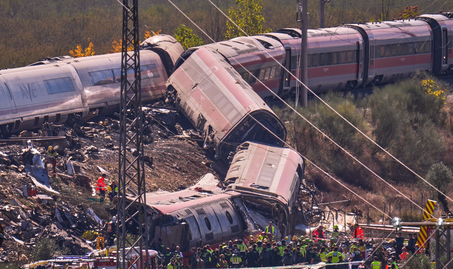
Spain began three days of national mourning on Thursday, October 29, 2026, after a devastating collision between two high-speed trains in the central province of Toledo killed at least 69 people and injured scores of passengers, prompting renewed scrutiny of railway safety and leaving families anxiously searching for missing relatives.
Also read: Climate Resilience Remains a Global Priority
The crash occurred on Wednesday morning near Urda, in the Castilla-La Mancha region, when a train operated by state-owned Renfe struck the rear of a stationary service operated by private rail company Iryo on the high-speed line connecting Madrid and Seville.
The death toll rose from 68 to 69 on Thursday as emergency crews continued searching through twisted carriages and debris. Rescue workers deployed cranes, sniffer dogs and thermal drones to locate victims, while police and forensic teams worked to identify the dead.
The disaster has become one of Europe’s deadliest railway accidents in recent decades and marks Spain’s second fatal high-speed rail collision this year, intensifying questions about the country’s railway safety systems and the decisions made before the impact.
Prime Minister Pedro Sánchez visited the crash site and pledged a thorough investigation, promising that authorities would establish what happened and identify any failures that contributed to the tragedy.
“We are working day and night not only to support the victims’ families, but also to establish every last detail of this tragedy and strengthen safety measures to ensure it never happens again,” Sánchez said.
The investigation has focused on an apparent failure involving the railway’s automatic signalling and control arrangements, followed by a decision to allow the Renfe train to resume its journey while the Iryo service remained stationary.
Transport Minister Óscar Puente said an automatic control system had failed along a stretch of track, forcing several trains to stop.
However, the control centre subsequently authorised the Renfe service to continue at normal speed despite the circumstances.
Puente described the decision as “inexplicable”, raising questions about how the movement of trains was managed after the system failure. Investigators are examining communications, operational procedures and the sequence of decisions that preceded the collision.
Authorities have not yet established a definitive cause, and the investigation remains ongoing. The circumstances surrounding the control centre’s decision, rather than any conclusion about individual responsibility, remain central to the inquiry.
For survivors, the collision left scenes of sudden devastation. Josimar Medina, a 31-year-old Peruvian tourist travelling in Spain with his girlfriend, described being thrown into the air while sleeping aboard the Renfe train.
“I woke up, and I was in the air,” Medina said, recounting the moments when the collision transformed an ordinary journey into a fight for survival.
Another passenger, 42-year-old Pablo Mejia, said a last-minute decision to change seats may have saved his life. Suffering head injuries, Mejia described a scene of overturned luggage, torn-out seats and passengers trapped among the wreckage.
“There was a very strong hit… a lot of people on the floor, on top of each other, seats ripped out, suitcases, a lot of chaos,” he said.
Reflecting on his survival, Mejia added: “I think I’ve been born again.”
As rescue operations continued, the emotional burden shifted towards families waiting for news of relatives who had been aboard the trains.
A school in Urda was converted into a support centre where relatives could seek information, with Red Cross personnel providing psychological assistance to those waiting for confirmation about their loved ones.
Red Cross psychologist Carmen Garcia warned that the coming hours would be difficult for families struggling to process the scale of the disaster.
“We have people who are in shock, who haven’t taken on board what has happened, angry people, sad, worried people,” Garcia said, adding that the grieving process would be complicated.
Local religious leaders also joined emergency personnel in supporting relatives. Parish priest Jose Miguel Fernandez said some families remained calm while others were desperate for immediate answers.
The Spanish royal household announced that King Felipe VI and Queen Letizia would visit injured passengers receiving treatment at a hospital in Toledo on Thursday.
Across the country, flags were flown at half-mast, while official ceremonies and public events were cancelled or scaled back as Spain observed the mourning period.
The latest collision has also revived painful memories of a separate railway disaster in January, when a high-speed train collision in Andalusia killed 46 people.
That accident involved a train derailment and a collision with another train on an adjacent track, and its investigation remains ongoing.
The two accidents have intensified debate over investment, maintenance and the management of Spain’s rail network.
The government has faced criticism over railway safety following the earlier disaster, although investigators have not established that the two crashes shared the same cause.
Train drivers began a previously scheduled strike on Thursday to demand stronger safety protections.
The industrial action had been called before the latest collision, but the disaster has given renewed urgency to concerns over working conditions and operational safeguards.
The latest crash has also disrupted travel on the Madrid-Andalusia high-speed corridor.
Renfe said services between Madrid, Ciudad Real and southern destinations had been interrupted, with alternative conventional rail services being arranged to help passengers continue their journeys.
For Sánchez’s government, the tragedy presents a major public test as investigators work to establish responsibility and families await answers.
The country is also approaching a general election scheduled for November 29, adding political pressure to the demand for transparency.
The immediate priority, however, remains the recovery and identification of victims, support for survivors and their families, and a full account of the events that led to the collision.
With the investigation still in its early stages, Spain’s authorities face the difficult task of determining whether the disaster resulted from operational errors, technical failures or a combination of factors.
Also read: Artificial Intelligence Is Changing How Businesses Work
The findings are expected to shape the next steps in the country’s efforts to strengthen railway safety and restore public confidence.




Pingback: Akwa Ibom Police Nab Masquerades Over Alleged Threats, Extortion – FreshUpdates News