

US Air Travel Disruption Hits Nigerians as Airlines Battle Flight Cancellations
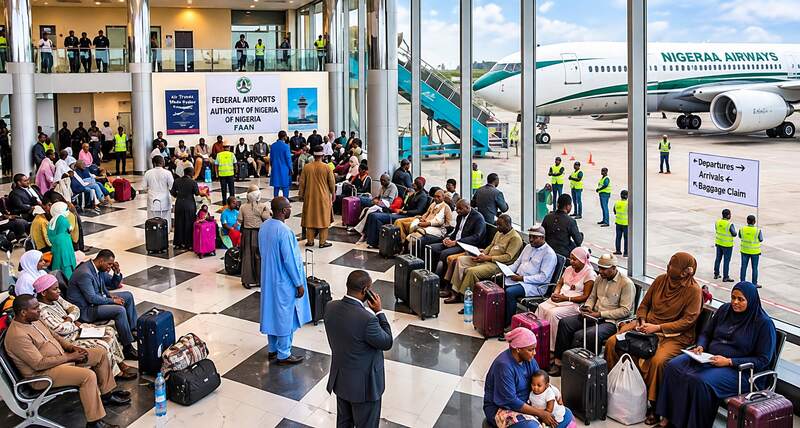
Hundreds of Nigerian travellers have been forced to postpone trips, return home or endure lengthy airport delays after a US nationwide aviation disruption left airlines struggling to restore normal operations
Hundreds of Nigerian travellers have suffered travel disruptions following a nationwide air traffic control ground stop in the United States, with flight cancellations, lengthy delays and operational difficulties leaving passengers uncertain about their journeys between both countries.
Also read: Airlines Spend $25bn Annually on Payment Processing – IATA
The disruption, which began on Friday, November 13, 2026, affected major airports across the US and continued into Sunday, November 15, as airlines struggled to restore their schedules and reposition aircraft and flight crews.
Although the Federal Aviation Administration (FAA) lifted the nationwide ground stop on Friday evening, the impact continued to affect international passengers, including Nigerians travelling to the US and those scheduled to return home.
Findings by The PUNCH showed that several Nigerian passengers scheduled to travel over the weekend were unable to embark on their journeys as planned.
Some were forced to postpone their trips, while others spent hours at airport terminals or booked nearby hotel accommodation in the hope that normal operations would resume within a day.
For some passengers, the prolonged uncertainty eventually made returning home the only practical option.
A passenger, Sola Aina, told The PUNCH on Sunday that he had abandoned his travel plans after spending days waiting for his flight to be rescheduled.
Aina, who said he had initially booked a Friday flight, explained that he checked into a hotel near the airport after learning about the disruption, believing the situation would be resolved before Sunday evening.
“I just have to return home today. I have come for a Friday flight before we heard of the troubles in the U.S. I have to sleep in a hotel since Friday believing that the issues would be sorted before Sunday night, but this is almost 7:00pm again now.
“I have ordered a cab. I have to return to Ibadan. It’s very painful but I don’t have an option,” he said.
Another passenger, Faruq Akinwale, said the disruption had complicated his plans to return home urgently, particularly because his wife and sick child were in the United States.
Akinwale appealed to the relevant authorities and aviation operators to accelerate efforts to restore normal flight operations.
“I have a sick child with my wife in the U.S. and I need to return home urgently, but what do I do? But I understand that no one can be blamed for this, but I will only appeal that everyone concerned should please hasten up whatever they are doing, I pray God help them,” he said.
Similarly, a mother of two, Mrs Aderemi, said the disruption had left her family with little choice but to abandon their immediate travel plans and return home.
“We will just return home, the situation is just understandable even though it’s painful,” she said.
Another passenger, Charles Adekunle, also confirmed that the development had affected his travel arrangements.
The disruption has extended beyond passengers departing Nigeria, with travellers scheduled to return from the US equally facing uncertainty, particularly those booked on international connections through major American aviation hubs.
Airlines operating services between Nigeria and the United States, either directly or through connecting routes, include Qatar Airways, Turkish Airlines, Ethiopian Airlines, Emirates, Virgin Atlantic and British Airways.
The situation has highlighted how disruptions within the US aviation network can affect international journeys, even when passengers are travelling on airlines headquartered outside the country.
According to Reuters, the nationwide ground stop was triggered by a communications failure affecting the US air traffic control system, resulting in widespread cancellations and delays.
The FAA said the technical problem began at approximately 3:30pm Eastern Time on Friday, November 13, prompting the agency to halt departures nationwide as a precautionary safety measure.
In an update published on Sunday, the agency explained that its legacy equipment became unstable after an unusual volume of data flooded its telecommunications network, affecting aircraft communications and radar feeds.
The initial investigation identified possible locations linked to the excessive data traffic at a radar facility in Amarillo, Texas, and a radio communications site in El Dorado, Arkansas.
The agency also disclosed that L3Harris, its network service provider, had been carrying out work involving the deployment of a new router at the Arkansas facility.
The FAA subsequently isolated the affected locations and disabled certain functions on similar routers as a precaution.
The agency said the system had stabilised and air traffic operations resumed at approximately 8:15pm on Friday, although airlines needed additional time to recover from the disruption.
The US Department of Transportation disclosed that air traffic controllers and commercial pilots safely grounded more than 3,500 flights during the incident, while over 8,000 flight operations resumed after the restriction was lifted.
However, the disruption had already generated substantial pressure across the aviation industry.
Reuters reported that nearly 10,000 flights had been cancelled by late Friday night, with thousands of passengers stranded at airports across the country.
The news agency also reported that the incident represented the longest nationwide aviation shutdown since the September 11, 2001, attacks.
US Transportation Secretary, Sean Duffy, acknowledged the scale of the disruption, praising air traffic controllers, pilots and other aviation personnel for managing the situation.
“We had 3,500 aircraft in the air. We had a ground stop and they safely landed all of our aircraft which was outstanding,” Duffy said.
He also pointed to the age of the country’s aviation infrastructure, particularly its telecommunications network, as a major concern requiring substantial investment.
The incident has renewed attention on the condition of America’s air traffic control infrastructure, which has faced longstanding concerns over ageing equipment, communication difficulties and staffing shortages.
Meanwhile, Delta Air Lines, one of the major US carriers, said it was continuing to restore its operations following the disruption.
In an update published on Sunday, November 15, the airline announced an extension of its flexible rebooking arrangements for affected passengers travelling between November 13 and 16.
Delta said passengers could change their bookings without additional charges through its mobile application or official website.
The airline also encouraged customers with flexible travel schedules to move their journeys to Monday, November 16, or later.
“While most flights are operating normally, some customers may still experience delays or cancellations,” the airline said.
Delta added that affected passengers would receive updates about schedule changes, while those whose flights were cancelled would be automatically rebooked on the next suitable itinerary.
The airline also advised passengers travelling on Sunday and Monday to allow additional time and check their flight status before heading to the airport.
The development comes amid differing assessments of when normal operations would resume.
FAA Administrator, Bryan Bedford, had initially expressed confidence that airlines would achieve full schedule recovery by the close of business on Sunday.
However, Duffy indicated that the recovery process would depend on how quickly airlines could reposition aircraft and crews displaced by the ground stop.
Although the FAA maintained that the system was stable and safe for operations, the continued adjustments to airline schedules meant that passengers could still face inconvenience beyond the initial shutdown.
For affected Nigerian travellers, the immediate concern remains the uncertainty surrounding departure dates, connecting flights, accommodation arrangements and the additional expenses associated with prolonged delays.
The disruption has also underscored the vulnerability of international travel to technical failures in major aviation networks, with consequences extending far beyond the country where the initial problem occurs.
Also read: MTN Nigeria Profit Surges 55% to N1.17tn in Nine Months
Passengers travelling between Nigeria and the United States have therefore been advised to confirm their flight status directly with their respective airlines before leaving for the airport and to seek clarification on available rebooking arrangements.




Pingback: No NIN, No Flight: Nigerians Question FG’s January Travel Rule – FreshUpdates News